
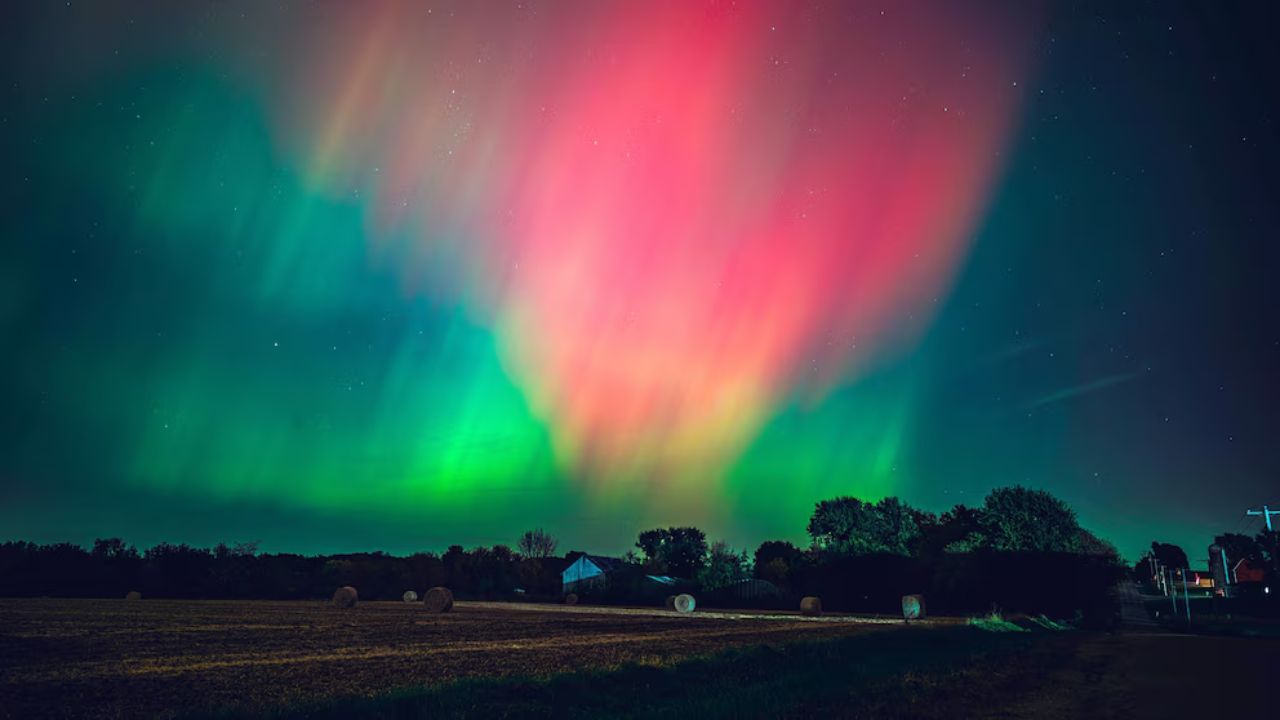
Boulder, Colorado — A burst of solar activity from the Sun could put on a dazzling display in Earth’s skies this week, with forecasters warning of incoming geomagnetic storms that may allow millions of Americans to catch a rare glimpse of the northern lights.
The forecast follows a solar flare and a coronal mass ejection, or CME, that erupted from the Sun and is now heading toward Earth.
Solar Flare Triggers Geomagnetic Storm Watches
The National Oceanic and Atmospheric Administration’s Space Weather Prediction Center (SWPC) has issued a G3 geomagnetic storm watch for Monday and a G2 geomagnetic storm watch for Tuesday.
The alerts were issued after scientists detected a CME associated with an M1.8 solar flare that erupted over the weekend.
While the term “geomagnetic storm” may sound alarming, experts emphasize that these events are relatively common and typically cause little disruption for most people.
The solar flare may have caused limited interruptions to some high-frequency radio communications, but significant impacts to daily life are not currently expected.
What Is a Coronal Mass Ejection?
A coronal mass ejection occurs when the Sun ejects a massive cloud of charged particles into space.
When those particles interact with Earth’s magnetic field, they can trigger geomagnetic storms and produce colorful auroras, commonly known as the northern lights.
The stronger the storm, the farther south the aurora can potentially be seen.
Scientists measure geomagnetic storm strength using the Kp index, which ranges from lower levels of activity to more intense events capable of creating widespread auroral displays.
Current forecasts suggest the Kp index could reach 7, which corresponds to G3 storm conditions.
Northern Lights Could Be Visible Across Several States
If the storm reaches its projected strength and skies remain clear, many northern states could have an opportunity to view the aurora.
According to forecasters, the northern lights could become visible as far south as Oregon, Wyoming, Iowa and New York under favorable conditions.
People located slightly farther south may still be able to see the aurora near the northern horizon, especially when using smartphone cameras or professional photography equipment.
Forecast models from the University of Alaska Fairbanks suggest viewing conditions could potentially extend into parts of Kansas, Missouri, Kentucky, West Virginia and Maryland.
However, experts caution that aurora forecasts can change rapidly.
Forecast Remains Uncertain
One challenge facing forecasters is the immense distance between Earth and the Sun.
The Sun sits approximately 93 million miles away, making it difficult to accurately predict how solar material will interact with Earth’s magnetic field until it gets much closer.
Current forecasts indicate the strongest activity could occur during daylight hours Monday, when auroras would not be visible due to sunlight.
However, if geomagnetic activity remains elevated after sunset, skywatchers could have a much better chance of witnessing the northern lights.
Millions Under Flood Watches as Relentless Downpours Trigger Rescues and Swamp Roads Across U.S.
Why Space Weather Matters
Although most geomagnetic storms pass with little notice, stronger events can occasionally affect satellite systems, navigation equipment, radio communications and power infrastructure.
Space weather experts closely monitor incoming solar activity to help utilities, aviation operators and communication providers prepare for any potential disruptions.
For most people, however, the biggest impact may simply be the chance to witness one of nature’s most spectacular light shows lighting up the night sky.
Additional forecast updates are expected as scientists gather more information about the approaching CME and its likely effects on Earth.
Have you ever seen the northern lights in person? Share your experience or thoughts in the comments below.