Washington, D.C. — Skywatchers across the northern United States could be treated to a spectacular celestial display this week as a powerful solar storm is expected to bring the Northern Lights much farther south than usual.
Forecasters say a series of solar eruptions from the sun may create ideal conditions for viewing the colorful aurora borealis across several states Thursday night and possibly into early Friday morning.
Powerful Solar Activity Triggers Geomagnetic Storm Watch
The unusual viewing opportunity comes after the sun produced three separate solar flares in recent days.
Those eruptions generated coronal mass ejections (CMEs) — massive clouds of charged solar particles that are now traveling toward Earth.
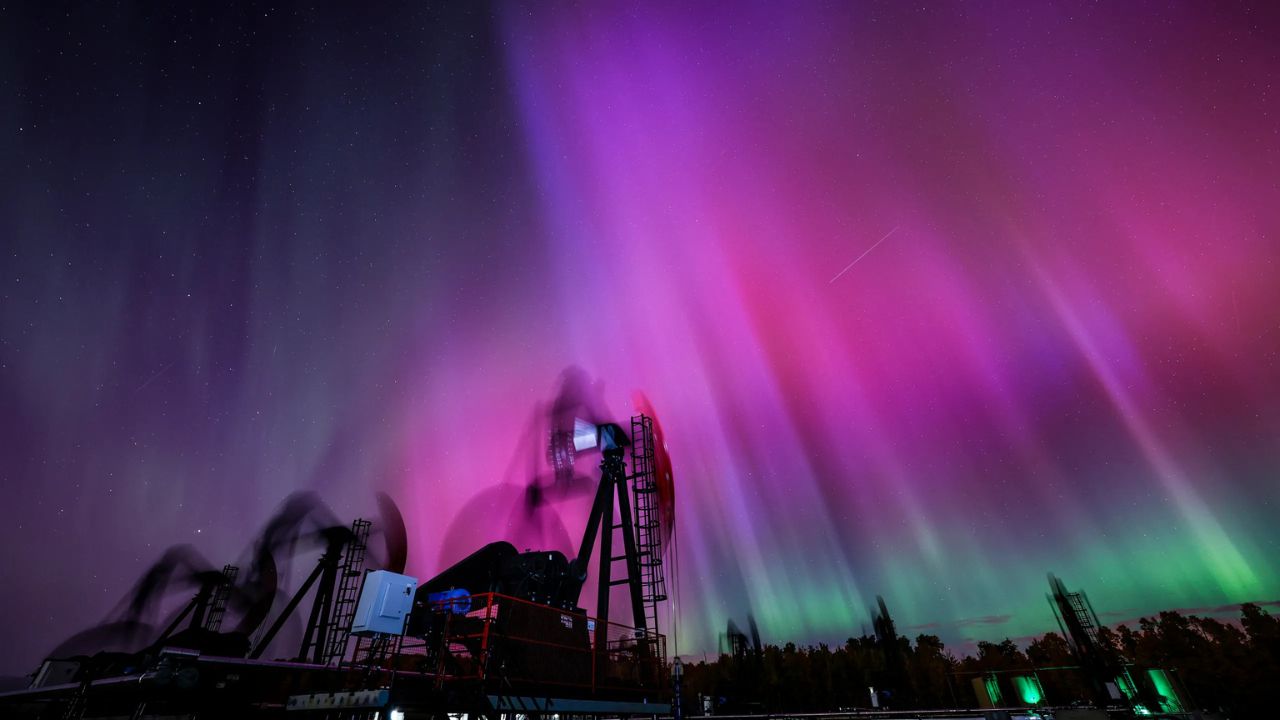
When these particles interact with Earth’s magnetic field, they transfer energy into the planet’s upper atmosphere, producing the glowing displays known as the aurora borealis, or Northern Lights.
Scientists say the interaction can also temporarily disturb Earth’s magnetic field, creating what is known as a geomagnetic storm.
Northern Lights Could Reach Major U.S. Cities
Because of the strength of the incoming solar activity, the National Oceanic and Atmospheric Administration (NOAA) Space Weather Prediction Center has issued a G3, or “strong,” geomagnetic storm watch for Thursday and Friday.
Under normal circumstances, the Northern Lights are typically visible only in regions close to the Arctic Circle and North Pole.
However, stronger geomagnetic storms can push the aurora much farther south.
Forecasters say the best viewing opportunities in the United States could extend as far south as Seattle, Washington; Chicago, Illinois; and Boston, Massachusetts.
In particularly favorable conditions, some observers even farther south could potentially catch glimpses of the phenomenon near the northern horizon.
What Causes the Northern Lights?
The Northern Lights occur when electrically charged particles from the sun collide with gases in Earth’s atmosphere.
These collisions release energy in the form of colorful light displays, often appearing as green, purple, pink and red waves dancing across the night sky.
The current event is being fueled by multiple CMEs, increasing the chances of stronger auroral activity.
Scientists note that the exact arrival time and intensity of the solar particles remain uncertain, and multiple waves could overlap as they reach Earth.
That uncertainty makes predicting the precise timing of the brightest displays more difficult.
Solar Storms Can Impact Technology
While the Northern Lights create stunning views, geomagnetic storms can also have practical consequences.
According to experts, strong solar storms can affect:
- Power grid operations
- Satellite communications
- GPS systems
- Radio communications
- Spacecraft and astronaut safety
Most people on the ground are unlikely to notice any major disruptions, but space weather experts continue monitoring conditions closely.
Heat Wave Alert: New York, Philadelphia and D.C. Set to Swelter Before Temperatures Crash
Best Ways to See the Aurora
For those hoping to catch a glimpse of the Northern Lights, experts recommend heading away from city lights and finding a location with a clear view of the northern sky.
Dark, open areas generally offer the best viewing conditions.
Weather may become a challenge for some regions, however, as parts of the same northern U.S. corridor expected to have aurora visibility are also forecast to experience severe weather over the coming days.
Even with those challenges, many skywatchers may have a rare opportunity to witness one of nature’s most spectacular displays without traveling to far northern destinations.
Have you ever seen the Northern Lights in person, or do you plan to look for them this week? Share your thoughts in the comments below.